

The overriding theme of our research is simple: money matters. More specifically, expanding liquidity drives asset prices higher, with monetary inflation hedges proving the greatest beneficiaries.
We believe the global economy remains in the early stages of what we describe as “Capital Wars”: an environment in which nation states play an increasingly dominant role in economic activity and monetary policy becomes progressively subordinated to fiscal funding requirements. We refer to this regime as Keynesian dominance: a structurally larger state sector combined with permanently elevated borrowing needs. Fiscal dominance describes a funding problem; Keynesian dominance describes a governing philosophy.
Under such conditions, monetary inflation becomes less a policy error and more a policy tool. Many observers describe this process as financial repression, but we believe that characterisation understates what is actually occurring. Financial repression suppresses returns on savings. Monetary inflation erodes the purchasing power of those savings themselves. One reduces income; the other destroys accumulated wealth.
The Case for Monetary Inflation Hedges
Asset allocation should therefore focus on preserving purchasing power through greater exposure to monetary inflation hedges.
Gold remains the longest-established hedge against monetary debasement. Bitcoin’s track record is far shorter, but its sensitivity to Global Liquidity has recently been approximately five times greater than that of gold. Consequently, a diversified basket of both assets, weighted according to their respective volatilities, appears a sensible approach.
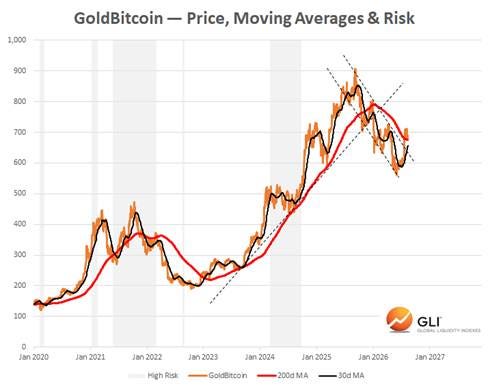
The chart below illustrates a gold-Bitcoin basket. After an extended period of weakness, the basket appears to be breaking higher, or at the very least has broken its previous downtrend. The technical picture warrants close monitoring.
The Case for Gold
In our view, China remains the principal driver of the gold bullion price.
China faces an enormous debt burden, while economic growth remains sluggish and inflationary pressures are subdued. Japan experienced a similar backdrop a decade earlier. Historically, one response to such circumstances has been to reduce the real value of debt through monetary expansion and currency debasement. In China’s case, this implies allowing domestic prices and wages to rise relative to the stock of existing debt through sustained liquidity creation.
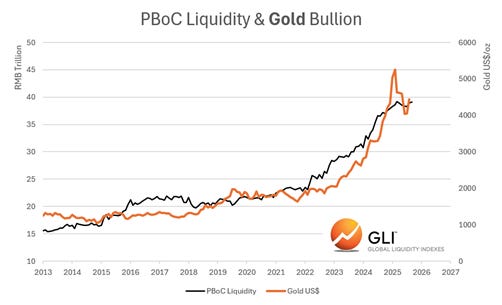
Because China maintains strict capital controls and limits access to alternative monetary inflation hedges, such as cryptocurrencies, gold has become the primary outlet for domestic demand seeking protection from currency debasement. This likely explains the strong relationship observed in the following chart between liquidity provided by the People’s Bank of China (PBoC) and the gold price.
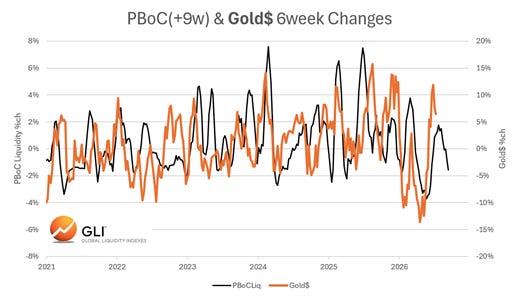
The next chart examines the relationship in greater detail by focusing on weekly changes in PBoC liquidity. While the relationship is far from perfect, it remains meaningful and appears to lead movements in bullion prices by approximately nine weeks.
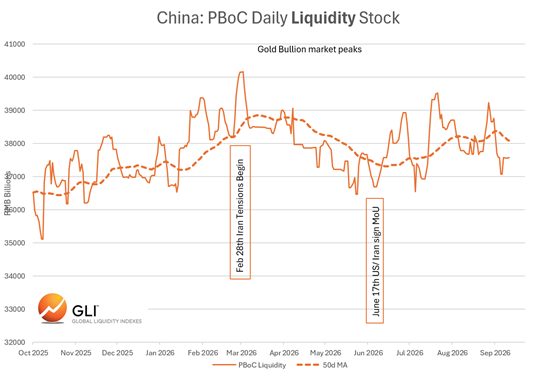
Recent Chinese data have been mixed. We previously highlighted how tensions surrounding Iran may have contributed to a deliberate slowing in PBoC liquidity growth, potentially aimed at moderating Chinese oil demand. Liquidity rebounded following the Memorandum of Understanding (MoU), but continued uncertainty surrounding the agreement may explain why liquidity growth remains only modestly positive. Daily liquidity data are shown below.
The Case for Bitcoin
Whereas PBoC liquidity is crucial for gold, cryptocurrencies appear considerably more sensitive to broader Global Liquidity conditions.
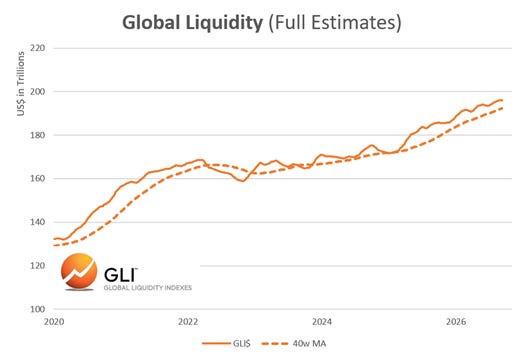
The latest weekly Global Liquidity data, shown in the next chart, indicate that although liquidity continues to expand in absolute terms, the rate of growth is slowing.
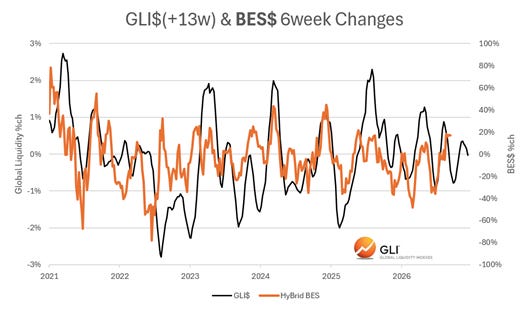
This matters because cryptocurrencies are highly responsive to changes in liquidity momentum. Slower liquidity growth has historically weighed on crypto performance. The relationship can be seen in the chart below, which compares a representative crypto basket (BES$ = 60% BTC$, 30% ETH$ and 10% SOL$) against Global Liquidity growth advanced by thirteen weeks.
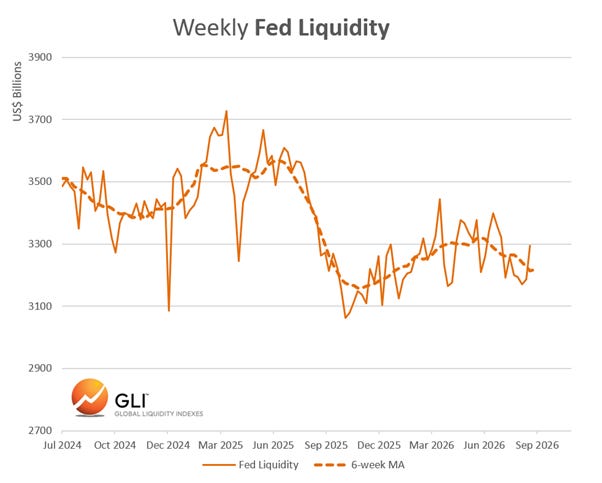
Part of the recent moderation in Global Liquidity reflects a slowdown in US Federal Reserve liquidity provision. This is consistent with the Fed’s ongoing effort to fine-tune money market conditions while maintaining what it considers adequate reserve levels and stable repo market functioning. As the next chart suggests, the near-term liquidity outlook may therefore be less supportive.
Investment Outlook
The strategic case for owning monetary inflation hedges remains compelling, even if the short-term tactical picture is more mixed.
Price action should be monitored closely for evidence that gold and cryptocurrencies are building durable bases from which to advance. Nevertheless, periods of weakness continue to look more like buying opportunities than reasons to abandon the broader thesis.
Global debt continues to expand exponentially, and financial stability ultimately requires a sustainable relationship between debt and liquidity. In practical terms, this means liquidity must grow alongside debt. The implication is straightforward: monetary inflation is likely to remain a persistent feature of the investment landscape.
Investors should remember that monetary inflation is not the same as consumer price inflation, nor is it synonymous with financial repression. Consumer price inflation reduces real incomes. Financial repression suppresses investment returns. Monetary inflation undermines the real value of accumulated wealth itself.
In such a world, monetary inflation hedges are not optional. They are increasingly essential.
4yr trend NGDP in Japan 4.3% Germany 4.2% France 3.8% UK 5.4%
We report the facts