
Bitcoin Liquidity
Is ‘Untrusted’ Money More Important For Bitcoin

Liquidity is a key influence on Bitcoin and other crypto assets, but is the liquidity that matters most, not simply total Global Liquidity, but the liquidity coming from economies where Bitcoin ownership is currently highest? This report examines this claim.
Consider the tight relationship between a crypto basket BES$ (Bitcoin 60%, Ethereum 30%, Solana 10%) and Global Liquidity – a US$195 trillion aggregate – reported in the chart below, using weekly data since 2021. We show 6-week log changes to eliminate ‘noise’. Global Liquidity leads by 13 weeks.
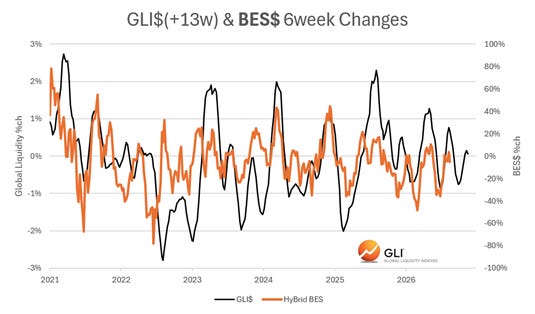
Bitcoin itself remains one of the purest expressions of Global Liquidity conditions. The long-term bull case for Bitcoin is strongly supported by its progressive adoption—the extensive margin—but the near-term investment case is again dominated by the liquidity cycle. In practical terms, Bitcoin should be accumulated when forward liquidity indicators are improving and risk allocation should be reduced when Global Liquidity is slowing.
Our key finding is that liquidity from higher-trust monetary systems, paradoxically, appears to provide the more reliable signal for Bitcoin, while liquidity from less-trusted systems has a larger but less consistent impact. This distinction matters because it separates the structural adoption story from the more volatile cyclical impulse created when investors in weaker currency regimes seek alternatives.
Main Points
Maintain a constructive long-term stance on Bitcoin because adoption still appears to be in the early stages of an S-curve
Tactically, avoid chasing Bitcoin during periods of slowing Global Liquidity; wait for liquidity momentum to stabilise or turn higher
Use ‘trusted-liquidity’ indicators as the primary timing signal because they show the stronger and more reliable relationship with Bitcoin price changes
Treat surges in ‘untrusted liquidity’ as a higher-beta catalyst: powerful when they occur, but less dependable as a standalone investment signal
What Drives Bitcoin?
Two broad forces drive Bitcoin and other cryptocurrencies. The first is the intensive margin: existing holders increasing or reducing the share of their wealth allocated to crypto. This is cyclical and is closely linked to movements in Global Liquidity. The second is the extensive margin: the spread of crypto ownership across a wider investor base. As with many new technologies, this is likely to follow an S-shaped adoption curve.
The structural incentive to own Bitcoin comes from concern that high fiscal deficits and rising public debt will eventually lead governments to debase their currencies. That supports the long-term bullish case. However, the cyclical liquidity backdrop can still dominate shorter-term returns, which explains why a positive long-term view can coexist with caution during periods of slowing liquidity.
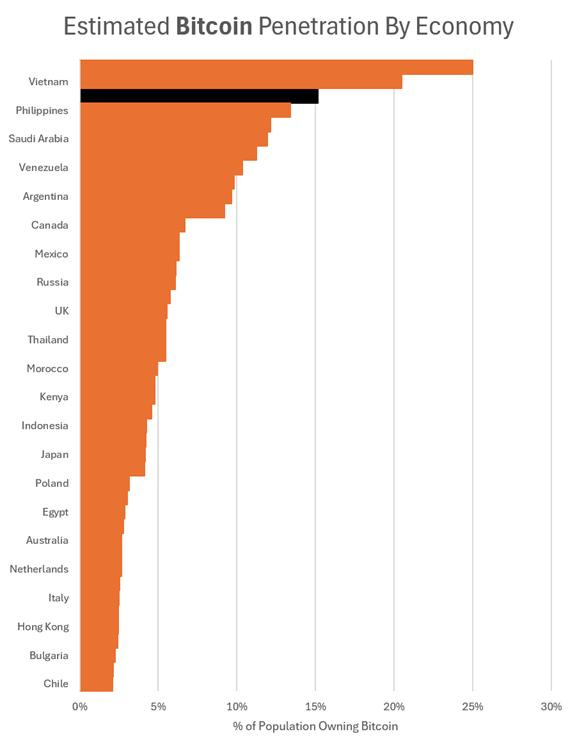
A useful refinement is to ask whether the liquidity that matters most is not total Global Liquidity, but liquidity coming from economies where Bitcoin ownership is highest. In effect, this splits global money into a more trusted pool and a less trusted pool. Economies with weaker monetary credibility may create a stronger incentive for holders to seek alternatives such as Bitcoin, although market exchange rates may already capture some of that risk.
Source: Google Search
To test this, survey estimates of Bitcoin ownership by country are paired with the size of each economy’s liquidity pool in US dollars. For example, if Bitcoin ownership is higher in Brazil than in Germany, Brazil’s liquidity pool receives a larger weight in the Bitcoin-adjusted aggregate. In other words, the higher the Bitcoin penetration, the greater the distrust we attribute to that paper currency. This is plainly a questionable assertion. We gathered data using Google Search (downloaded August 2026). The data are imperfect and should be treated as approximate, but they provide a practical way to distinguish between standard Global Liquidity and a Bitcoin-relevant liquidity pool.
On monthly data, the weighted liquidity aggregate moves broadly in line with standard Global Liquidity, but with important differences. If liquidity in high-Bitcoin-ownership economies accelerates relative to the US or other large trusted monetary systems, the weighted aggregate can rise faster than the headline measure. This is the practical investment value of the exercise: it identifies when Bitcoin-sensitive liquidity is diverging from the global aggregate.
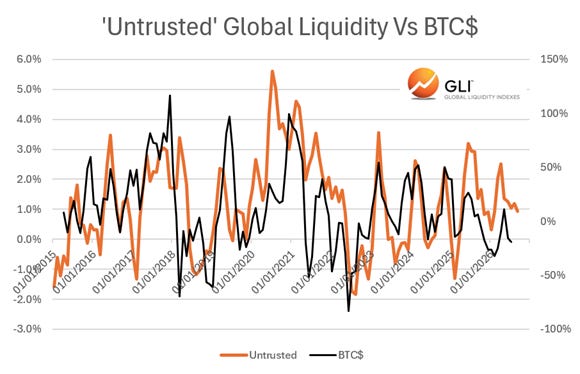
The chart below tracks the pools of ‘trusted’ and ‘untrusted’ Global Liquidity, monthly since 2020. The two time series are subtly different.
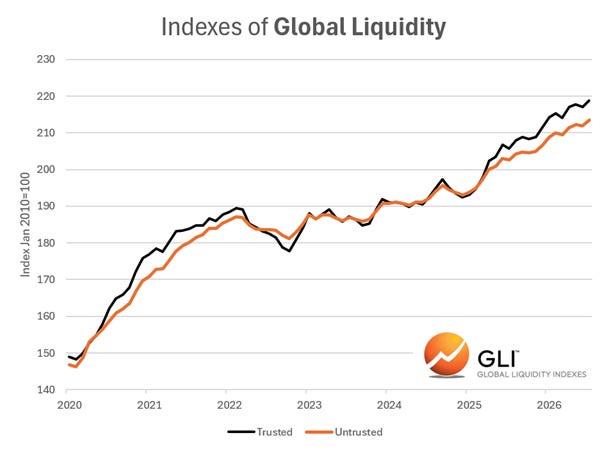
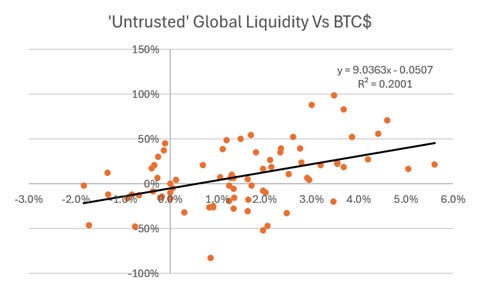
The regression results over 2020–26 suggest two conclusions. First, trusted liquidity has the higher correlation with Bitcoin price changes, making it the more dependable guide for timing exposure. Second, untrusted liquidity has the higher beta, meaning that when it does move, the impact on Bitcoin can be larger. The trade-off is between reliability versus magnitude.
‘Trusted liquidity’ appears to capture the structural adoption channel and provides the cleaner signal for Bitcoin price changes.
‘Untrusted liquidity’ captures the currency-debasement channel and can generate larger price moves, but with weaker consistency.
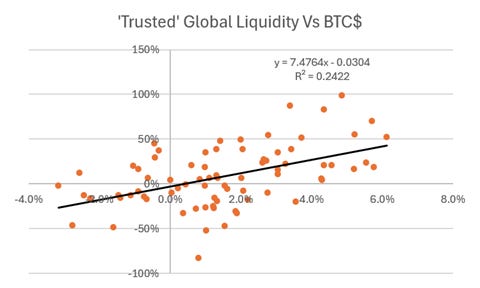
The relationship with ‘trusted liquidity’ is economically meaningful. The first chart below is a time series and the second chart reports the scatter plot taken from 2020 onwards. Using three-month log changes, and advancing liquidity by three months to show that it leads, the correlation coefficient is around 0.5. The estimated beta is roughly 7.5 times, implying that a 10% annualised liquidity expansion would be consistent with an approximate 75% Bitcoin price move over the following three months, all else equal.
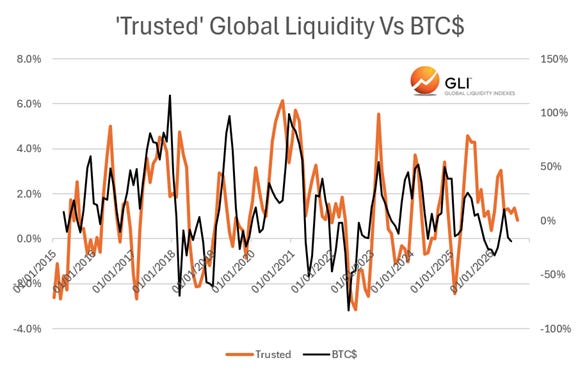
The untrusted-liquidity relationship is different. The correlation is lower, at around 0.4, but the beta is higher, near 9.0 times. This means that ‘untrusted liquidity’ is a less reliable timing tool, but potentially a more powerful accelerant when it turns sharply higher.
Investment Implications
For investors, the implication is straightforward: Bitcoin exposure should be managed through a liquidity framework rather than a purely valuation-based framework. The strategic allocation case remains intact, but tactical positioning should be linked to the direction and composition of Global Liquidity. The best environment for Bitcoin is one in which ‘trusted liquidity’ is improving and ‘untrusted liquidity’ is also accelerating, because that combines a reliable signal with a high-beta impulse.
This has been an useful exercise, but we will continue to monitor crypto investment prospects through the single lens of Global Liquidity, The division into ‘trusted’ and ‘untrusted’ pools, while interesting, is not sufficiently rigorous and anyway the willingness of monetary authorities to debase their paper monies is likely already largely captured by movements in market exchange rates.
Disclaimer
The information is provided for information purposes only and on the basis that it will not be relied upon. No information contained herein constitutes a personal recommendation or investment advice.
The information (including any expressions of opinion or forecast) have been obtained from, or is based on, sources believed by the author to be reliable, but are not guaranteed as to their accuracy or completeness and should not be relied upon. The information is provided without obligation on the part of the author and on the understanding that any person who acts upon it or changes his investment position in reliance on it does so entirely at his own risk. The information does not constitute an offer to buy or sell or an invitation to make an offer to buy or sell any financial instrument.
Information is current only as at the date it is first posted and may no longer be true or complete when viewed by you. All information may be changed or amended without prior notice.
No representation, warranty or undertaking is given as to the accuracy or completeness of the information by the author and no liability is accepted by the author for the accuracy or completeness of such information. In no event will the author be liable to any person for any direct, indirect, special, or consequential damages arising out of any use of the information, including, without limitation, any lost profits.
You should be aware that the Internet is not a completely reliable transmission medium. The author does not accept any liability for any data transmission errors such as data loss or damage or alteration of any kind, including, but not limited to any direct, indirect or consequential damage, arising out of the use of the product or services referred to herein.
The materials provided here including text, photographs and other images, are protected by copyright and/or other intellectual property rights. All copyright (and any other intellectual property rights) in these materials is either owned by the author, or is used by the author under licence.
Thank you, Michael. Please be sure to give us a heads up when you see the tides turning for the asset.
Michael — if gold is mainly tracking China's PBoC liquidity cycle and Bitcoin tracks the rest-of-world liquidity cycle, and those two cycles run out of phase, could a dynamic gold/Bitcoin basket — tilting toward whichever cycle is currently expanding — outperform a static 50/50 hold? Or is that too simplistic, and is it worth back testing?